










Human beings have always been afraid of the unknown
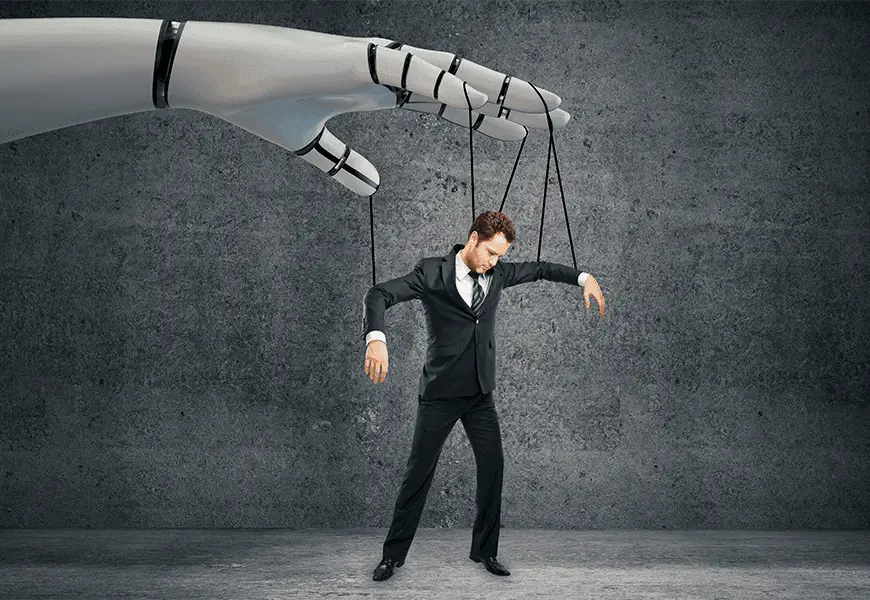
This is the catastrophic scenario imagined by some of us. Human beings have always been afraid of the unknown. This lack of control is at the root of this form of xenophobia. According to most experts, the risks are minimal that artificial intelligence will become uncontrollable and take over humanity.
Nevertheless, it should be noted that OpenAI CEO Sam Altman considers the development of artificial intelligence to pose an extinction-level threat to humanity. He advocates for government intervention to regulate artificial intelligence.
The risks
However, certain risks exist when artificial intelligence falls into the wrong hands. It can be used for criminal purposes or to spread disinformation. Several malicious uses can be identified, including in particular:
- Identity theft and deepfakes, by creating manipulated videos that overlay one person’s image onto someone else’s;
- The hacking of autonomous vehicles. In 2015, two white hats (ethical hackers, as opposed to black hats), Charlie Miller and Chris Valasek, took control of a Jeep Cherokee driven by journalist Andy Greenberg;
- Phishing, a form of online fraud. This involves using personalized, automated messages to increase effectiveness in collecting sensitive information or installing malware;
- The hacking of AI-managed systems—for example, disrupting or controlling rail traffic;
- Etc.
Beyond these risks, several challenges must be addressed regarding the development and use of artificial intelligence. These include, among others, ethical, economic, data protection, social, decision-making accountability, and legal challenges.
Ethical challenges
The most tangible risks are ethical in nature. Artificial intelligence can, for instance, be discriminatory. It is largely built on data that does not always account for context. It may also rely on historical data that has marginalized racial minorities, women, and other groups. This heavy dependence on data makes it difficult to handle exceptions—at least for now. The metadata on which AI systems are trained can contain a significant number of biases and underlying assumptions, which may have consequences for certain groups in terms of inequality and injustice. This is what is known as informational bias. The absence of consciousness—and, above all, empathy—can make it difficult to understand human motivations and attitudes.
Economic challenges
The adoption of artificial intelligence can reinforce existing economic inequalities. Companies with substantial financial and technological resources have an advantage in adopting AI, which can widen gaps between large and small businesses, or between developed and developing countries.
Data protection challenges
The use of artificial intelligence often requires access to large amounts of data, including personal data. This raises concerns about privacy and data security, and requires the implementation of appropriate regulations and protective measures.
Added to this is a major challenge related to mass surveillance. CCTV footage, location data, electronic messages, audio recordings, and more all represent intrusions into individuals’ privacy. Companies and governments can use such data—and various persuasion techniques—to manipulate behavior.
Social challenges
Beyond the discriminatory aspects mentioned earlier, artificial intelligence can also affect employment. AI-driven automation may lead to the elimination of certain jobs, particularly those that are routine or based on predictable tasks. This could create economic disparities and require measures to help workers transition to new jobs.
In addition, artificial intelligence can create addictive behaviors. The quality of the user experience—and sometimes its immersive nature—can lead to a form of dependency on AI-driven interfaces. Excessive reliance on these systems can make societies vulnerable in the event of technological failures, outages, or cyberattacks.
Challenges related to accountability in decision-making
When AI systems make decisions that affect individuals, it is important to determine who is accountable in the event of errors or harmful consequences. The opacity of AI models and the lack of clear accountability create challenges in this area.
Legal challenges
Artificial intelligence raises questions about appropriate regulation and legislation. At present, there is no legal framework governing the use of artificial intelligence, and there is a lack of standards for transparency, accountability, and security.
As noted earlier, AI systems often require significant amounts of personal data to operate effectively. This raises concerns about the protection of privacy and personal data.
The issue of accountability arises when autonomous AI systems make decisions. Such decisions can have a significant impact on individuals and society. Who is responsible in the event of erroneous decisions or harm caused by AI systems?
In summary
Artificial intelligence has confronted us with a set of unavoidable challenges, as we are facing a major revolution that nothing can stop. It is up to us to adapt and find ways to make the most of it. AI should be seen as a tool that can help increase efficiency, innovation, and productivity in many fields, which can lead to significant economic, social, and environmental benefits.
Not only is it essential to establish clear mechanisms of accountability and responsibility for the stakeholders involved in the development and use of artificial intelligence, but it is also important to implement regulations that protect individuals’ privacy and govern data use within an ethical, transparent, and responsible framework.