









A radio spot that promises a personal touch, a Facebook page that talks about nothing but promotions, a printed catalog that is three years out of date. Every channel exists. None of them works for the others: that is exactly what 360° communication sets out to fix.
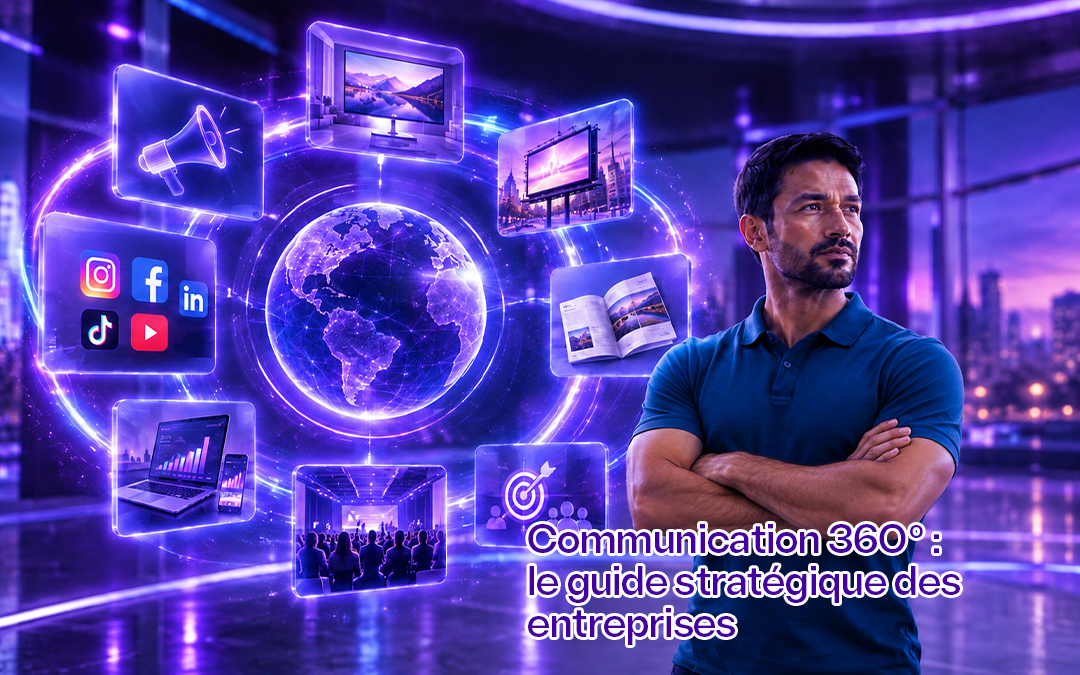
360° communication promises to clear up exactly this kind of mess. But first, we need to agree on what it covers, because the term is often used as a sales pitch rather than as a working method. In reality, a successful approach is never judged by the number of channels activated, but by how consistently they tell the same story together.
Here are three guidelines before going any further. First, it is not about adding up channels: it is about orchestrating them around a single goal. Second, the message matters more than the medium; a fuzzy message broadcast everywhere is still a fuzzy message, just a more expensive one. Finally, consistency has to be managed, with a shared calendar, a single owner and shared metrics.
What Is 360° Communication, in Practice?
The principle fits in one sentence. 360° communication means surrounding your customers with consistent touchpoints, from mass media to private messages. The goal: they encounter the same brand at every stage of their journey. The number therefore refers to covering that journey, not to how many channels you buy.
This distinction changes everything in practice. Many business leaders hear "360" and think "everything." Yet no company, not even the world's biggest advertisers, activates every available channel. They select, prioritize, then synchronize. Well-executed 360° communication is therefore, above all, an exercise in saying no. Anything else is a waste of budget.
One clarification is also in order, because it heads off plenty of misunderstandings in meetings. Communication serves marketing; it does not replace it. We explain this boundary in our article on the differences between marketing and communication. In other words, all 360° communication rests on a prior marketing decision: which target audience, which promise, which positioning.
The Mistake Many Companies Make
The most common mistake is confusing presence with strategy. You open an account because a competitor did, you buy a billboard because an opportunity comes up, you launch a newsletter because an intern knows how to run one. Each decision makes sense on its own. Put end to end, however, they do not add up to anything.
Here is a simple illustration. A luxury house does not advertise on a classifieds website, not out of contempt for the medium, but because the context in which a message appears is an integral part of the message itself. The channel is never neutral: it colors what you say as much as your own words do. Choosing a channel is therefore already saying something about your brand.
A second pitfall is just as costly: mechanical repurposing. Reusing the same poster in a square format for Instagram, then as a banner for the website, means ignoring the codes of each channel. The result: content that works nowhere, even though it was designed for one specific place. Consistency is not about repeating; it is about translating.
Our Tips for Coordinating Your Company's Communication
Here is the sequence we systematically apply at our agency. It works for a ten-person SME just as well as for a regional group; only the scale of resources changes.
- Start with your business goals. Brand awareness, foot traffic, qualified leads or recruitment: each goal calls for a different setup. A plan that does not name its goal cannot be managed.
- Set one key message. A single promise, expressed in one sentence, that all your channels will carry for at least a year. Without this foundation, consistency remains wishful thinking.
- Choose your channels based on your target audience. The question is not "Which channels exist?" but "Where are my customers really, and when are they receptive?"
- Adapt without diluting. The same promise everywhere, but executed according to the grammar of each channel: fifteen seconds on radio, three words on a billboard, a demo in vertical video.
- Orchestrate the calendar. 360° communication is all about sequencing: mass media builds awareness, digital captures the demand it has just created, and the point of sale closes the deal.
- Measure, then adjust. Define two or three metrics per channel before launch, not after. What has not been measured can never be weighed up.
This sequence seems obvious on paper. Yet it runs into a hard reality: in most companies, channels are managed by different people who rarely talk to each other. That is exactly where consistency gets lost, far more than in the choice of channels.
Which Channels Should You Activate in 360° Communication?
The Tunisian media landscape is more balanced between traditional channels and digital levers than you might think. According to Mediascan data published by Managers for June 2026, traditional media spending broke down as follows: out-of-home 46%, TV 36%, radio 16% and print 1%. The total reached 24.13 million dinars, excluding taxes, for the month of June alone.
These figures do not, however, cover digital spending, which largely escapes local measurement. Yet the Digital 2026 Tunisia report counts 10.4 million internet users and 7.83 million active social media users. In other words, 360° communication has to strike a balance between two worlds, only one of which is actually measured.
| Channel | Channel type | What it delivers | Use it when… |
|---|---|---|---|
| Television | Offline | Fast awareness, credibility, national reach | Product launches, FMCG, mass-market brands |
| Radio | Offline | Frequency, local roots, low cost per contact | Foot traffic, time-limited offers, regional coverage |
| Out-of-home (OOH) | Offline | Visual impact, recall, geographic proximity | Store openings, urban awareness, very short messages |
| Events & PR | Offline | Proof, direct relationships, legitimacy | B2B, corporate launches, niche industries |
| Social Media | Online | Closeness to customers, precise targeting, regular content | Always, whatever your industry or company size |
| Organic SEO | Online | Lasting visibility, traffic with no cost per click | Existing demand, long decision cycles |
| Google Ads | Online | Instant capture of purchase intent | You need fast results, people actively search for your offer |
| Site & e-mailing | Online | Conversion, customer retention, first-party data | Always, as the foundation of the whole plan |
Each of these levers deserves its own in-depth treatment. That is why we have published complete guides to your social media, SEO and Google Ads advertising in Tunisia. To build the digital side of your plan, our eight-step method is the most direct starting point.
Where to Start Your 360° Communication, Depending on Your Budget
The answer depends less on your industry than on your production resources. Here are three setups we regularly see in the Tunisian market.
A Small Business on a Tight Budget
Start with the digital foundation: a clear website, an up-to-date Google Business Profile, one well-managed social media account and a modest search advertising budget. This base costs anywhere from a few hundred to a few thousand dinars a month, depending on scope, and it delivers measurable results within the first quarter. Only add a traditional medium once this foundation is stable.
An Established Regional Business
At this stage, add a local layer. Regional radio and urban out-of-home build awareness that digital alone struggles to create, especially among less connected audiences. This is where the plan becomes true 360° communication: offline builds recognition, and online captures the demand it generates.
A National Advertiser
TV becomes relevant again once your distribution is national and your average basket size is large enough. However, it only works when tied to everything else: without digital support and in-store activation, a TV spot generates recall, but rarely attributable sales.
What You Gain
The benefits show up on four levels. First, brand consistency: a company that says the same thing everywhere becomes recognizable, and therefore memorable. Second, reach: channels reinforce one another, and someone exposed twice through different channels remembers far better than after two identical exposures.
Third, efficiency. A budget allocated by goals rather than by habit naturally delivers a better return. Finally, risk management: relying on a single channel leaves your business exposed to the slightest change in algorithms, pricing or regulations.
A concrete example shows how this works. For a product launch, the TV spot builds awareness in the first week. Out-of-home then sustains visibility for a month, social media fuels the conversation, and email marketing converts the existing customer base. None of these channels would be enough on its own. Together, they produce an effect far greater than the sum of their individual performances: that is the whole point of 360° communication.
Getting Support: The Role of a 360° Communication Agency
360° communication often runs into an organizational obstacle rather than a budget one. The TV spot goes to a production company, social media to a freelancer, out-of-home to a media sales house, the website to a developer. Each one does their job properly, yet no one is responsible for the consistency of the whole.
That is exactly the value of an integrated agency: a single team designs the strategy, writes the key message, adapts it across every channel and allocates budgets between channels. You save coordination time, but above all you avoid the contradictions that end customers notice immediately. We have outlined the different models available on the market in our article on advertising agencies in Tunisia.
Frequently Asked Questions
What is 360° communication?
360° communication is an approach that coordinates every touchpoint between a brand and its audience, both online and offline. All of them then serve a single goal and a single message. What matters is not the number of channels, but how consistently they fit together along the customer journey.
Where should you start with 360° communication?
Start 360° communication with your business goals, then express your key message in one sentence. Only after that do you choose your channels. Reversing this order is still the most common mistake, and the most costly one.
Do you really need to use every communication channel?
No, you do not need every channel, and trying to use them all is actually counterproductive. Three well-executed channels are better than eight half-managed ones. Select the channels where your target audience actually is, then focus your resources there.
Which channels make up 360° communication?
360° communication combines offline channels, such as TV, radio, out-of-home, events and the press, with online channels, such as social media, SEO, online advertising, email marketing and your website. The right mix depends on your target audience, your sales cycle and your budget.
How do you keep your message consistent across all channels?
To keep your message consistent across all channels, write a one-page brand platform: promise, proof points, tone of voice, mandatory visual elements. This document becomes the reference for all your vendors. A single review before publication is then usually enough to prevent things from drifting off course.
Do you need an agency for 360° communication?
You do not necessarily need an agency for 360° communication, but coordination is a job in its own right. Once you go beyond three or four active channels, an integrated agency often costs less than the internal time spent getting separate vendors to work together.
So here is the key takeaway: 360° communication is not a question of budget, but of method and discipline. A clearly named goal, a single key message, channels selected and then synchronized, and metrics tracked month after month. At 5 Sens Advertising, an advertising agency in Tunisia with offices in Tunis, Sousse and Doha, we design and manage these programs from end to end. We have a name for this standard: scientific rigor in the service of creativity, which has guided our work since 2020.
Are your channels really working together? Request a free assessment of your communication setup, or let's grab a coffee and talk it through.