









In FMCG naming, a brand name is not judged in a meeting room. It is judged at the counter of a grocery store in Sfax, when a customer has to say it out loud. It is also judged in front of a search bar, when that same customer has to type it. In Tunisia, this two-part test plays out in two languages and two scripts.
In consumer goods, the name is the asset that works the longest. Packaging changes, campaigns come and go, but the name stays. Yet many FMCG naming projects are still decided on gut feeling. Here is how to replace intuition with a simple testing protocol designed for a bilingual market.
In short. Here are three guidelines before you sign off on a name:
- One name, two lives: it must be easy to say and write in both French and Arabic, including in Tunisian Arabic (Derja).
- The counter test: if the shopkeeper does not understand the name when a customer asks for it, the product will not be sold.
- Measure recall, not liking: a name people like but forget within 48 hours is a bad name.
Why FMCG Naming Follows Its Own Rules
Consumer goods are bought quickly, often without much thought. According to research by the Ehrenberg-Bass Institute, a brand's growth depends above all on its mental availability: the likelihood that it comes to mind at the moment of purchase. And the name is the primary vehicle for that availability.
As a result, an FMCG name does not need to be brilliant. First and foremost, it needs to be easy to process. In 2006, Alter and Oppenheimer showed in PNAS that stocks with easy-to-pronounce names outperformed, in the short term, those with hard-to-pronounce names. The mechanism has a name: processing fluency. In other words, what the brain processes effortlessly feels more familiar, and therefore more trustworthy.
Next, the name has to survive being spoken. In 2013, Luna, Carnevale and Lerman found that a name heard aloud is better remembered when its spelling is obvious. This dual coding, auditory and written, strengthens recall. Conversely, a name whose spelling remains ambiguous gets lost somewhere between the ear and the keyboard.
The Tunisian Challenge: One FMCG Name, Two Languages, Two Scripts
According to the International Organisation of La Francophonie, around 52% of Tunisians speak French. In practice, the shelf is bilingual, but consumers are not always bilingual to the same degree. Some shoppers read the Latin script first, others read Arabic first. And at the counter, everyone speaks Tunisian Arabic.
An FMCG name intended for the Tunisian market must therefore clear four hurdles, and each one can weaken it:
- Reading in French, when a shopper reads the pack;
- La transcription en arabe, quand le nom est transcrit sur l’emballage ou dans une publicité ;
- Then reading in Arabic, when an Arabic speaker reads the name without short vowels;
- Finally, typing, when a customer searches for the brand on Google or Facebook, often in Arabizi (Arabic written with Latin letters and numbers).
And each hurdle can distort the name. That is why a name that looks excellent on paper can turn into three different brands in shoppers' minds once it hits the shelf.
The Phonetic Pitfalls of FMCG Naming Between French and Arabic
Some sounds do not exist in both languages. For example, "p" and "v" have no native equivalent in Arabic. As a result, some people naturally say "Bebsi" instead of "Pepsi." Likewise, French nasal vowels and the French "u" and "eu" sounds pose the same kind of difficulty.
The other way around, the letters ع, ح, ق and خ have no single Latin transliteration. As a result, a name built on these sounds will end up with several spellings, including Arabizi numerals such as 3, 7 or 9. For online search, this fragmentation is costly.
| Criterion | French version | Arabic version |
|---|---|---|
| Pronunciation | Avoid nasal vowels and the "u" and "eu" sounds in the key syllable | Avoid "p," "v" and heavy consonant clusters |
| Spelling | Only one plausible spelling when heard | Only one possible reading, even without short vowels |
| Online search | Consistent spelling on Google | Few, predictable Arabizi variants |
| Connotation | No negative meaning in French | No negative meaning in Modern Standard Arabic or Tunisian Arabic |
| Visual design | Legible at small sizes on the pack | Visual length close to the Latin version for the bilingual logo |
Finally, sound symbolism plays a role in both languages. In 2004, Yorkston and Menon showed that the vowels in a name influence how the product is perceived. An open sound tends to evoke creaminess or richness, while a closed sound suggests lightness. You therefore need to check that these associations remain consistent from one language to the other.
The 6-Test Protocol for Validating an FMCG Name
At 5 Sens Advertising, we run every shortlisted FMCG name through a short sequence of tests. It starts with the least expensive ones, then weeds out weak names at each step.
1. The Linguistic Screen
First, a panel of native speakers checks the name's meaning in French, Modern Standard Arabic and Tunisian Arabic. Nearby export markets, such as Algeria or Libya, should also be considered. A single awkward meaning is enough to eliminate a candidate.
2. The Cold Reading Test
Next, the written name is shown, first in Latin script and then in Arabic, without being pronounced. Each participant then reads it aloud. The metric is simple: the share of identical readings. If pronunciations differ, the name will fragment through word of mouth.
3. The Dictation Test
Then the exercise is reversed. The name is said aloud once, and each participant writes it in the script of their choice. The resulting variants are then counted. The fewer there are, the easier the brand will be to find online.
4. The Delayed Recall Test
This is the heart of the protocol. First, the name is shown among six to eight others, including real competitor brands. Then, 24 to 48 hours later, participants are asked which names come to mind unprompted. Aided recognition is measured last. Unaided recall remains the decisive metric, because it reflects mental availability.
5. The Counter Test
This test simulates the neighborhood grocery store, where the product often sits behind the counter. One participant asks another for the product out loud, and the second must pick it out from several packs. For many FMCG products in Tunisia, this is the test closest to the real buying situation.
6. The Association Test
Finally, participants are asked what the name brings to mind: a category, a benefit, a price level. In 1998, Keller, Heckler and Houston showed that a suggestive brand name makes the advertised benefit easier to recall. However, a name that is too descriptive will be harder to protect as a trademark.
Testing an FMCG Name: Sample and Interpreting the Results
For FMCG naming, the sample must reflect the linguistic reality of the target audience. We recommend at least three groups: French-dominant speakers, Arabic-dominant speakers and balanced bilinguals. Ideally, the sample should also mix Greater Tunis, the Sahel region and the interior regions.
As a rough guide, 30 to 50 participants per group are enough for an exploratory phase. Beyond that, a quantitative online test can confirm the final choice. The thresholds below are working benchmarks, not absolute standards.
| Test | Metric | Benchmark |
|---|---|---|
| Cold reading | Share of identical pronunciations | ≥ 80% in each group |
| Dictation | Number of spelling variants | No more than 2 dominant variants |
| Delayed recall | Unaided recall after 48 hours | Above the average of the names tested |
| Counter test | Product identified on the first request | ≥ 85% of attempts |
| Association | Correct category association | Majority of responses |
Above all, compare the results by group. For example, a name that shines with French speakers but fails with Arabic speakers is a risk. It splits your market in two instead of bringing it together.
Du naming FMCG testé à la marque protégée
A name approved by the public is not yet a usable name. First, you need to check its availability with INNORPI, the body that manages trademarks in Tunisia. A trademark registered there is protected for ten years, renewable. Also make sure to register both the Arabic and the Latin-script versions.
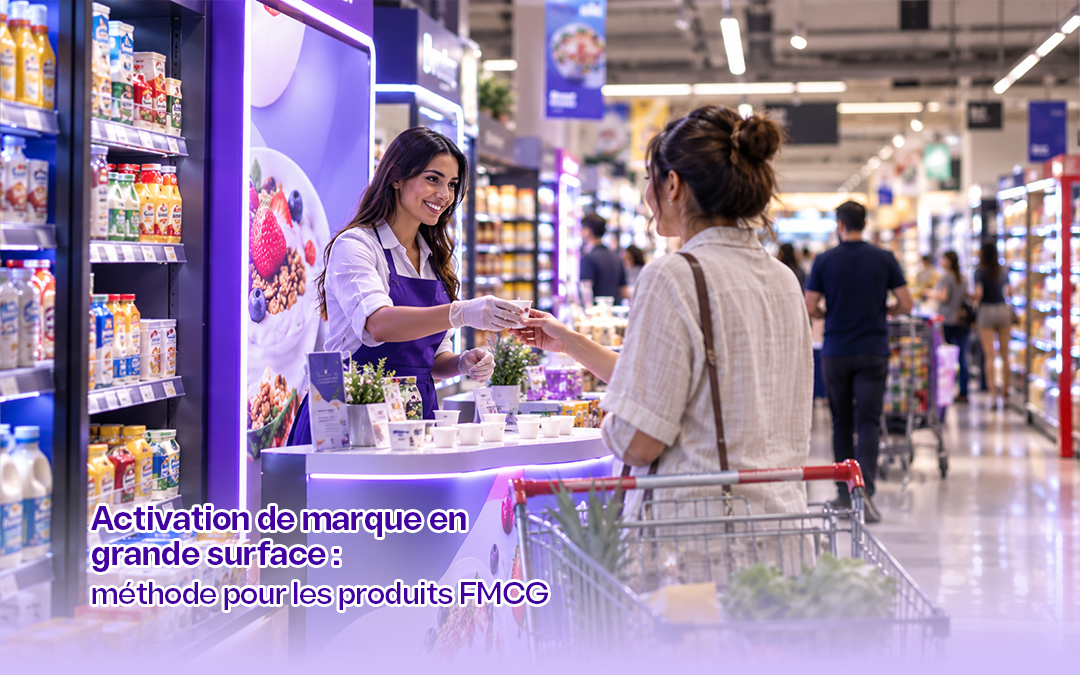
Next, check the .tn and .com domain names, as well as the social media handles. Then comes the identity work: the bilingual logo, the Arabic typeface and consistency on the shelf. On this point, the in-store sales levers are a reminder that visibility is also won at the shelf. This is also where the name becomes part of a broader brand marketing strategy.
The Bilingual FMCG Naming Checklist
- Naming brief defined: target audience, category, positioning, price.
- Linguistic screen passed in French, Modern Standard Arabic and Tunisian Arabic.
- Consistent cold reading in both scripts.
- Few spelling variants in the dictation test.
- 48-hour unaided recall measured against competitors.
- Counter test passed.
- Associations aligned with the brand positioning.
- Availability checked with INNORPI, for domain names and on social media.
- Trademark filing planned for both the Latin-script and Arabic versions.
Frequently Asked Questions
What is FMCG naming?
FMCG naming is the process of creating and selecting a name for a consumer goods brand or product. It combines creativity, linguistic analysis, consumer testing and legal checks.
How do you test an FMCG brand name before launch?
To test an FMCG brand name, measure pronunciation, spelling, delayed recall and associations with the target audience. Unaided recall after 24 to 48 hours remains the most reliable metric.
Should a brand name in Tunisia be Arabic or French?
Neither, as a matter of principle. The right name is one that is easy to say and write in both languages. In FMCG naming, a short, phonetically simple name often works better than a translation.
What makes a brand name easy to remember?
A brand name is easy to remember when it is short, obvious to pronounce and has only one spelling. Research on processing fluency shows that the brain retains best what it processes effortlessly.
How do you protect a brand name in Tunisia?
A brand name in Tunisia is protected by filing a trademark with INNORPI. Protection lasts ten years and is renewable. A prior trademark search is therefore strongly recommended.
How many names should you test?
You should usually test three to five shortlisted names. Beyond that, participants get tired and the delayed recall results become less reliable.
At 5 Sens Advertising, we see the name as a brand's first investment, and its most lasting one. As an advertising agency in Tunisia, we support consumer goods brands from naming all the way to the shelf. This is what we call scientific rigor in the service of creativity.
Planning to launch a new brand or product range? Request an assessment of your project or contact our team to test your names before you commit.