










Les chiffres clés du digital
Major trends in the digital landscape
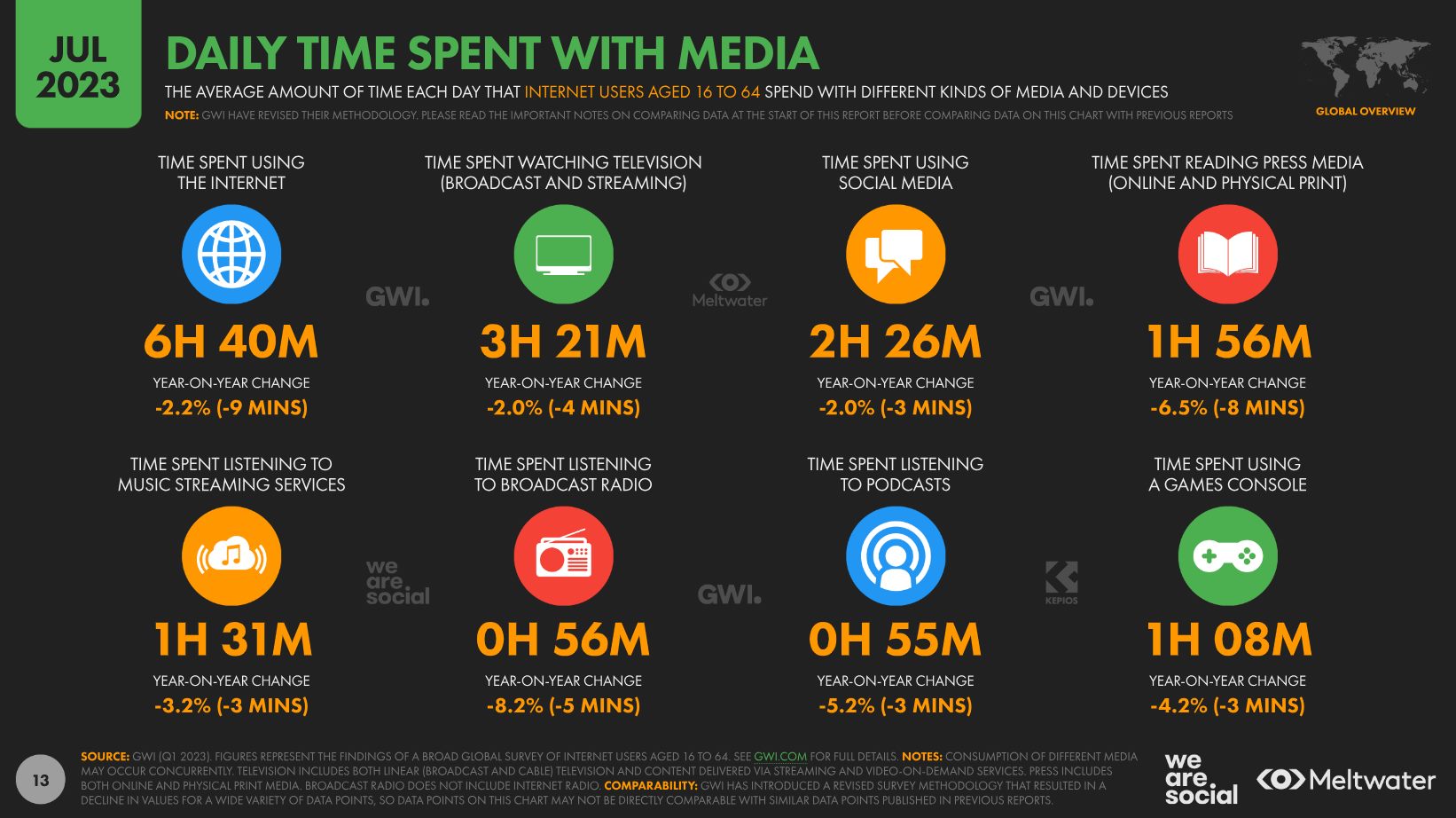
According to the latest data in the report on the digital landscape, an intriguing trend is emerging: users appear to be spending less time online. This is reflected in an overall decline in average usage across different media over the past year. Notably, time spent on the internet decreased by 2.2%, while time spent on social media fell by 2%.
However, despite this decline in average usage time, the number of internet and social media users continues to grow, with respective increases of 2.1% and 3.7%. This can be interpreted as the result of a steadily expanding user base, even as people distribute their time online more evenly.
An interesting observation concerns device usage. Smartphones saw a slight increase of 0.8%, highlighting their growing importance in our everyday digital habits. By contrast, personal computer usage fell by 3.4%, while tablets experienced an even sharper decline of 7.8%. This shift underscores changing user preferences, with a clear preference for smartphones as the primary means of accessing online services.
These figures offer a compelling snapshot of current digital habits and underscore the importance of understanding changing user behaviors in order to adapt digital strategies and offerings as effectively as possible. This highlights an increasingly dynamic digital world.
Le temps passé sur les médias digitaux
The Internet: A world where two-thirds of the population is connected
The report’s latest data reveals fascinating statistics on global internet usage. Here are the key figures to remember:
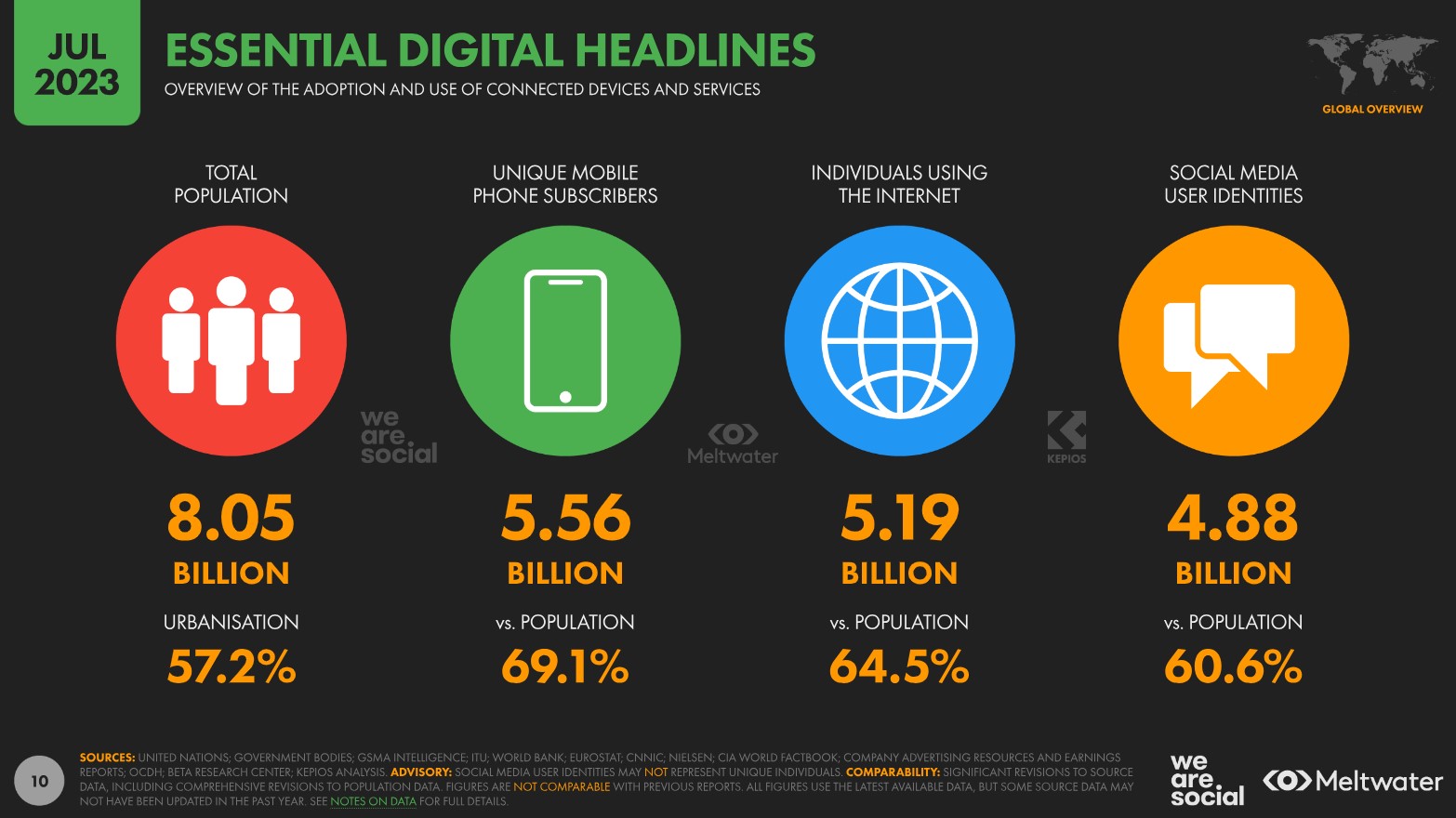
In July 2023, there were 5.19 billion internet users worldwide, representing 64.5% of the global population. This underscores the growing importance of digital connectivity on a global scale.
The average time spent online per day is estimated at 6 hours and 40 minutes. This figure highlights how pervasive digital usage is in the daily lives of many people around the world.
Accessing the internet via a smartphone is predominant, with 95.3% of users worldwide using it as their primary means of connection. By contrast, access via a computer is declining, with only 63.4% of users choosing this option. This trend highlights the growing preference for smartphones as the preferred gateway to the online world.
A major reason for going online for 59.2% of users is to search for information. This pursuit of knowledge remains the primary motivation for using the web, underscoring its crucial role in finding answers and resources.
Google Chrome dominates the browser market with an estimated 62.58% market share. This success highlights its popularity and users’ preference for it as a web browsing tool.
As a search engine, Google continues to reign supreme with an impressive 92.64% market share. This overwhelming dominance underscores the trust users place in Google for their online searches.
The most visited website in the world is google.com, attracting an impressive 88.1 billion visits per month. It therefore outperforms other web giants such as youtube.com and facebook.com, demonstrating Google’s considerable influence in the global digital landscape.
Growing Stronger: Social media more powerful than ever
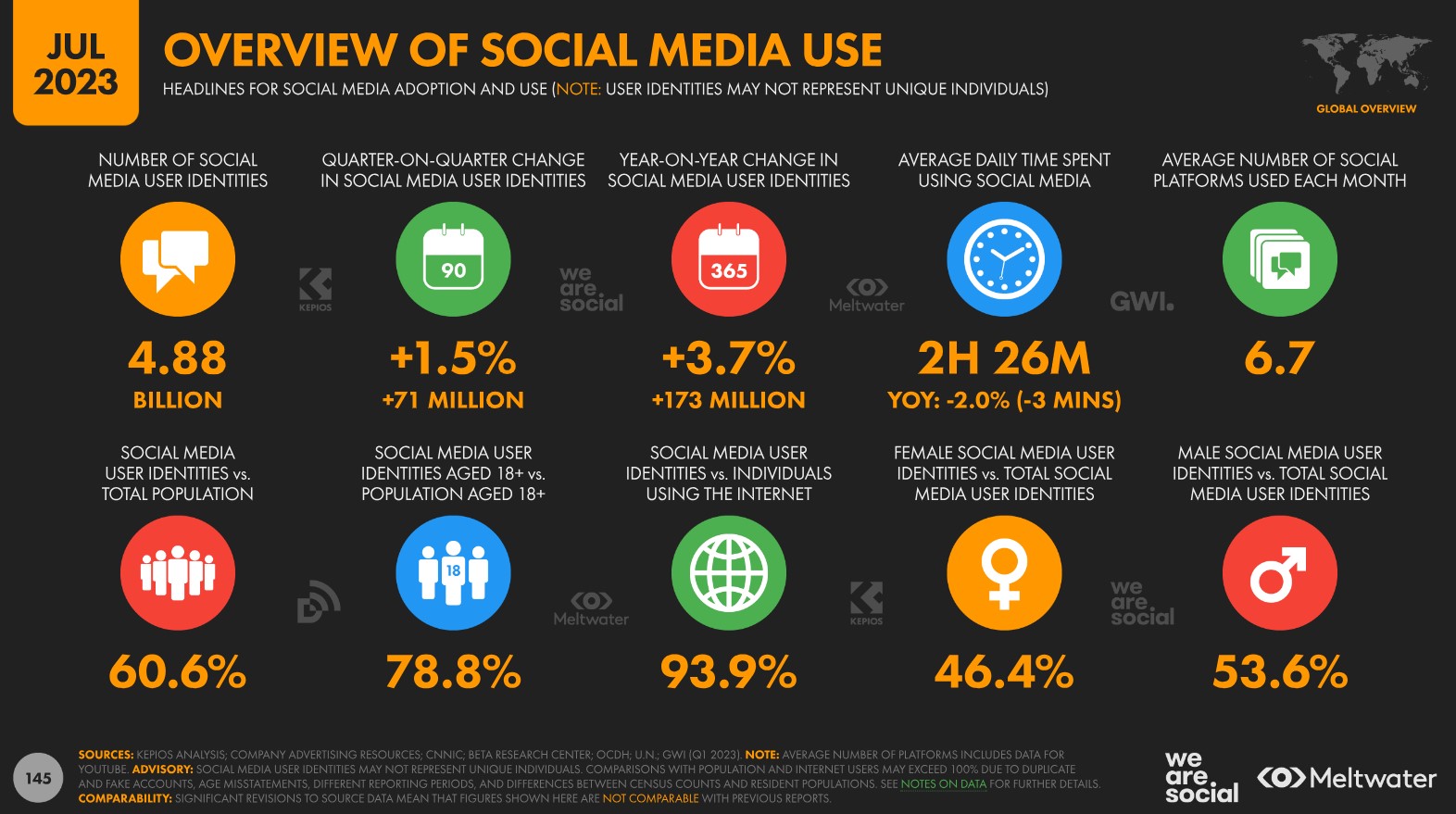
Since the pandemic, it is worth noting a clear increase in the number of social media users worldwide, with a significant rise of 3.7% in just one year, bringing the total to 4.88 billion users. Among them, 46.4% are women, while 53.6% are men. These figures demonstrate the continued growth in social media adoption, which is playing an increasingly central role in people’s daily lives.
As for time spent on social media, the global average is estimated at 2 hours and 26 minutes per day. This highlights the considerable appeal and influence these platforms have on users, prompting them to devote a significant share of their daily time to them.
The five main reasons for using social media reveal users’ needs and interests:
- Staying in touch with friends and family is the main reason for 48.6% of respondents. This underscores the essential role social media plays in maintaining meaningful social and emotional connections, especially in an increasingly connected world.
- For 37.3% of users, passing the time is a major reason for using social media. Social platforms offer a wide range of entertainment and content that captivates users, encouraging them to spend their leisure time there.
- Reading news stories is also an important activity for 34.6% of users. Social media has become a major source of information and narratives, where people can discover and share stories that interest them.
- For 29.8% of respondents, finding content is a key reason for using social media. Social platforms have become content discovery hubs, enabling users to access a wide range of media, posts, and creations.
- Keeping up with trends attracts 28.4% of users. Social media plays a key role in the rapid spread of trends, news, and popular topics, making it a go-to source for staying up to date.
Une vision globale de l’utilisation des réseaux sociaux
The power of social media in discovering new brands
According to We Are Social, social media has become an increasingly attractive playground for brands. It now ranks as the third leading source of brand discovery, just behind search engines and TV ads. About 27.7% of internet users aged 16 to 64 say they discover brands through paid placements on social platforms.
Among these platforms, Instagram stands out as the most effective leader: more than 62% of its users say they look for future purchases there or view brand content. This dominance makes Instagram an essential platform for brands seeking to reach their target audience and generate interest among potential consumers.
Generation Z Prefers TikTok for News and Information
TikTok ranks as the social platform where users spend the most time, with an average of 31 hours and 14 minutes per month per user. YouTube (27 hours and 21 minutes) and Facebook (18 hours and 22 minutes) complete the top three.
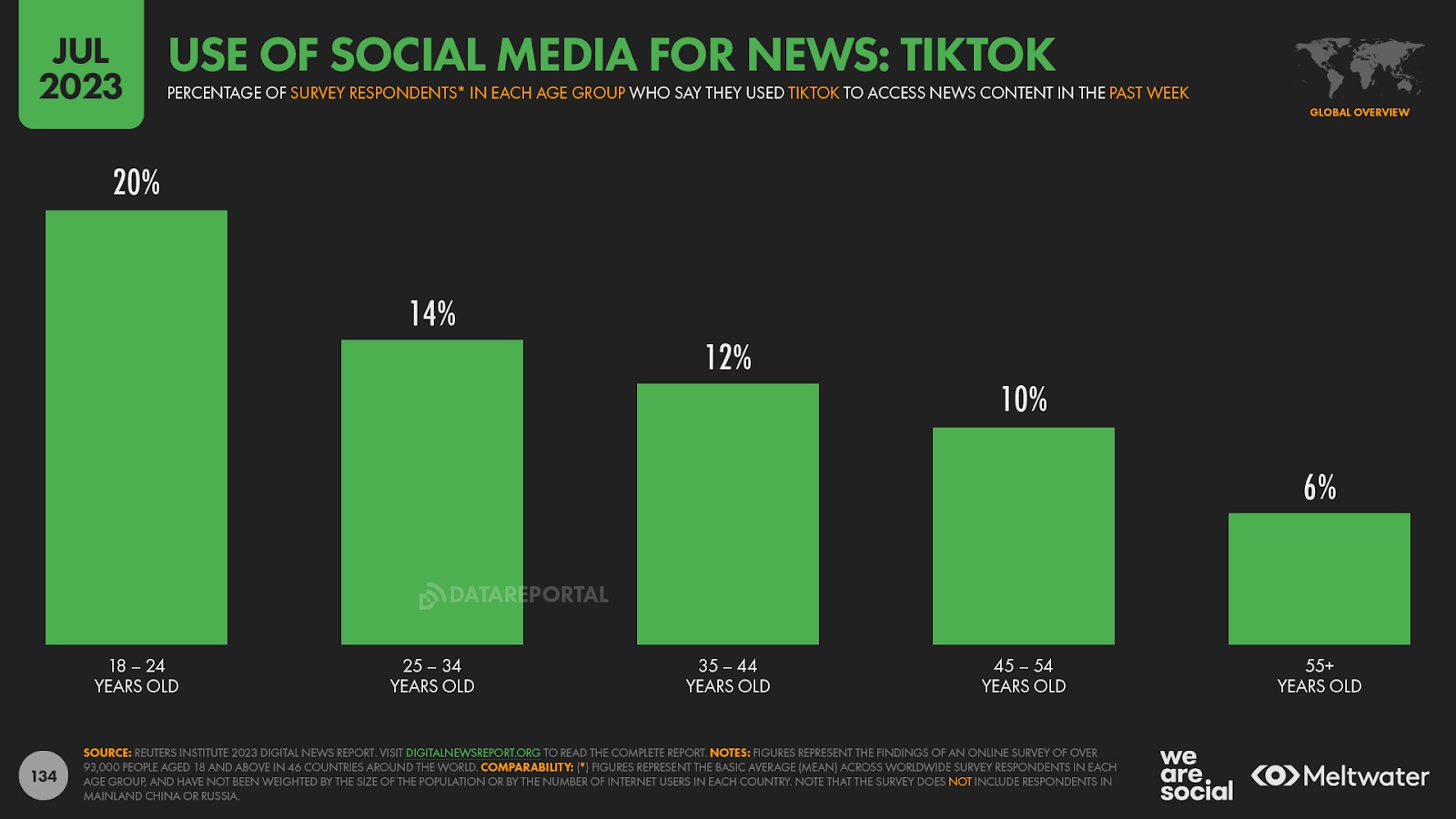
Moreover, the report highlights the growing use of TikTok for information purposes: 11% of respondents to the Digital News (RISJ) survey say they use the platform to follow the news, a share slightly lower than Twitter (12%). Among 18–24-year-olds, this figure rises to 20%. The number of people using TikTok as a news source increased by a remarkable 60% in just one year. This trend underscores TikTok’s growing role as a channel for news and informative content.
L’utilisation de TikTok chez la génération Z
Threads: The New Star of Social Platforms
The major social media disruption in recent months has been the arrival of Threads, Meta’s new app designed to compete with Twitter. The report states that Threads achieved phenomenal success, recording 150 million downloads and 100 million active users worldwide in just one week.
According to We Are Social, this remarkable breakthrough is due to Threads’ integration with Instagram. However, Meta’s main challenge will be retaining users on a different platform. GWI data highlights that Instagram users are more inclined to seek fun and entertaining content rather than follow the news. By contrast, Twitter’s primary use is to stay informed about current events. It will therefore be interesting to see how usage motivations evolve for the new Threads service and whether Meta succeeds in retaining users by offering a unique and appealing experience.